The Teas and C’s of Learning that Sticks
Learn Well: When Helping Too Much Steals the Learning
If you were at World of Learning, you might have seen me sketching out the Top Right model — and talking about how easily we can miss opportunities to help others learn well with their brains fully switched on.
Because when we’re on autopilot, heads down getting the job done, we often forget to pause. We forget to look up and notice the small, golden opportunities to enable someone else’s learning.
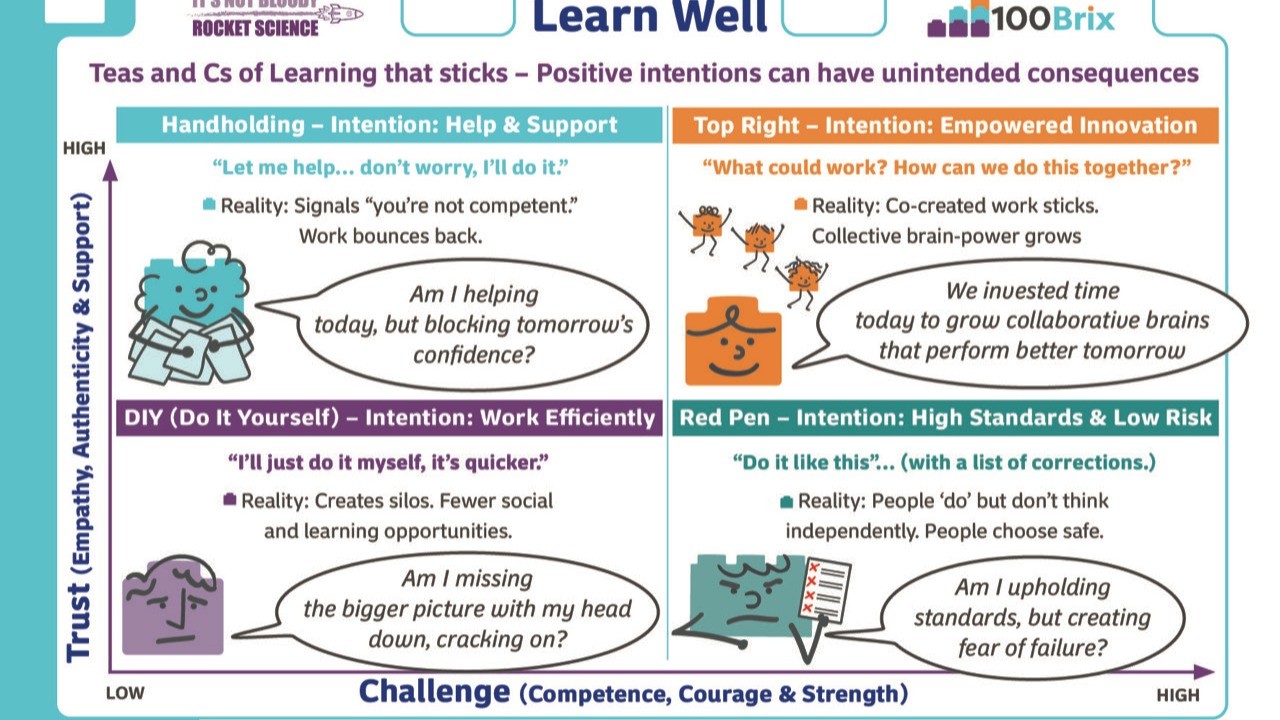
That’s what this little postcard (above👆) was created for — a special edition of my familiar Top Right model, designed to help us spot those moments where positive intentions accidentally block learning.
💬 The feedback that still makes me cry
When I first led an office based team in my thirties, I received a piece of feedback that still, even now, can make me tear up.
Not because it was harsh – quite the opposite. It was so true that it hurt.
The person giving it had noticed something I’d been doing on autopilot for years: stepping in to help, fixing things for people, taking work off their plates. I genuinely believed I was being kind, supportive – a model of servant leadership.
But here’s what they told me:
“You’re stealing people’s opportunity to learn.”
And they were right.
⚙️ The trap of good intentions
At that point, I’d been in the same business for more than a decade — operations, finance, property, commercial – I knew the people, the systems, the shortcuts. I was the go-to problem solver.
Someone would arrive at my desk with an issue and my instant response was:
“Don’t worry, I’ll fix it.”
It felt efficient. It felt caring. It also felt… good.
Being the fixer comes with a lovely dopamine hit of competence and usefulness.
But what I was really saying to the subconscious of the other person- without meaning to – was:
“You can’t do this without me.”
That’s the top-left corner of the postcard — high support, low challenge.
The positive intention: help and support.
The reality: it quietly signals, “You’re not competent.”
And when we do that, work bounces back. People come to us again and again, not because they can’t do it, but because we’ve trained them to believe they can’t — or shouldn’t try without checking first.
🔄 From “I’ll fix it” to “What could work?”
The shift to Top Right happens the moment we replace helping for someone with thinking with someone.
I learnt, through training to be a coach, that when someone came to me with a problem, a better default response was genuine, empathetic curiosity:
“What have you tried so far?”
“What else might work?”
“If money were no object and this were your business, what would you do?”
Each of these questions triggers that tiny neural “pop” — the moment a person connects a past experience to a current challenge.
Light bulb moments are a real thing! Every “pop” is a new neural connection — and once it forms, it sticks.
That’s what makes learning stick too.
📉 The other boxes we slip into
Looking back, I was guilty of spending too much time in the other boxes too.
In ‘Bottom Left’ – The DIY Zone
When I was swamped, I’d hide away, head down, “no more question time.” Productive, maybe. But it meant I wasn’t present for others to learn with me.
In a world where AI is removing so many entry-level roles, those small, incidental learning moments — the coffee queue question, the shoulder tap, the “Can I just check something?” — matter more than ever.
In ‘Bottom Right’ – The Red Pen Zone
And when stress took over, I could be sharp:
“Haven’t we had this conversation before?”
“You know how to do this so why are you asking me again?”
The intention was good -tough love, but it was delivered in a way that was likely to be received as a threat – because under pressure, my brain had flipped into fight, flight, freeze or appease as the person asking the question.
And when cortisol spikes (for both the person asking the questions, or for the person on the receiving end of them, the prefrontal cortex (our thinking brain) literally can’t think.
It’s an inconvenient, but un-swerveable truth that every manager needs to know
My reaction was making it less likely the other person would be able to think well, solve the problem and learn something for next time.
💡 The neuroscience of better learning
The Top Right corner – Empowered Innovation – is where learning lives. And all we have to do to access it, is know it’s there and come out of the autopilot zig zag most of us do – where one moment we are top left and the next moment, bottom right
Top Right – high support AND high challenge.
I now picture a bright orange LEGO-style brick to give me a visual reminder of what being in this space means.
Because like a kids building brick set, the first brick, the first tip right question, the first top right conversation is just the start.
When we stack them together, question by question, conversation by conversation, each co-created solution builds our relationship and our collective brain-power.
Top Right Conversations are not just about lifting your head up from the day job to give advice or direction and providing a single solution to a one off problem. They are the start of relationships where we genuinely build learning with others and for ourselves at the same time.
And you can check out ‘Why Orange?’ by having a quick look at the science made simple with me and Dr Iain Price (PhD) as we talked about the science of colour in our book DOSE.
So for a quick practise today – instead of “Let me help” or “Do it like this,” try:
“What could work?”
“How can we best think this through together?”
That kind of conversation co-creates work that clicks together and grows collective brainpower.
It builds psychological safety and confidence to think independently.
In brain terms, you’re activating dopamine and oxytocin (motivation and connection), while keeping cortisol low enough for the prefrontal cortex to stay online.
That’s when people feel both safe and stretched — the sweet spot for learning.
🧱Try this today – your Ebbinghaus nudge
Next time you see something that’s almost right — a report, an idea, a plan — resist the urge to fix it or point out every flaw.
Try this instead:
“Hey, I’ve got this piece of work you’ve been leading on. I have a few things that are great, and a couple of ‘even better ifs’. Is now a good time to run it through with you?”
That’s Top Right in action — support and challenge.
It keeps learning active, brains engaged, and confidence growing.
And when someone asks for help, resist the top-left “Don’t worry, I’ll do it” and the bottom-right eye-roll.
Instead say:
“Sure, let’s look at where you’ve got so far. What else might you try? How can I give you the confidence to take the next step?”
That’s how we help people learn well – not by doing it for them, not by keeping our heads down and, not by revealing our frustration, but by pausing long enough to think:
💭 “How can I help this person’s brain grow today?”
Because that’s what learning really is:
Building collective brix of brainpower that perform better tomorrow.
Find out more about how we do what we do at 100Brix hereHome
And for more bitesize science, Dulcie’s first book It’s Not Bloody Rocket Science is now available on Audible here https://amzn.eu/d/9tMlzXs
📮 Postcard: “Learn Well – Teas and Cs of Learning That Sticks,” ©100 Brix & It’s Not Bloody Rocket Science
Books by Dulcie


We listen. We understand. We are confident that we can create a bespoke solution
that really adds to your bottom line.