
The 8 Hats of Great Mentors: The Reassuring Strong Presence
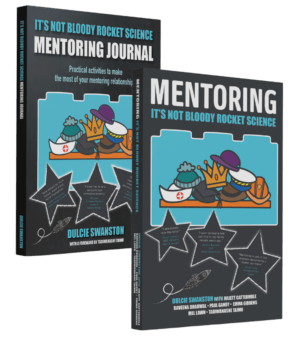
As I mentioned in the first of this 8-part newsletter series on mentoring, the biggest challenge that we experienced as a writing team when creating our book Mentoring – It’s Not Bloody Rocket Science was making sure that busy senior leaders taking on a mentoring role could quickly assimilate and remember the neuroscience that sits underneath successful human mentoring partnerships. At pace.
It took 2 years to distil everything into a simple training session that can be delivered in just 2 hours…
I have come to know over 20 years of creating ‘sticky’ training and writing about the science of learning that making the complex simple looks fast – but absolutely isn’t!
We will come onto the CAT in the final newsletter. For today we are focusing on another hat.
A Reassuring Strong Presence is something we seek out in a mentor. Someone who you equally trust as a person and trust in their expertise. So that when they tell you:
“You will be OK. This will pass. Trust me.”
we do trust them – and start to breathe again.
We use a nurse’s hat to embody this hat. Someone to lean into, who will look after you, firmly but kindly, when you are at your most vulnerable.
Wearing this hat takes skill – not too much sympathy so you create dependence. Not for too long so that someone stays stuck and feeling sorry for themselves.
Like the other hats, we can help mentors learn this skill. However, the hardest thing we found when researching this hat wasn’t how to wear it, but knowing when to wear it.
It is sometimes more difficult than it looks to try this hat for size in a mentoring meeting because people are complex:
We don’t always say what we mean; and we don’t always understand what we want; in order to effectively ask for the help we most need.
When we are feeling vulnerable, we might revert to saying things that don’t expose us too much and feel safe… like “What do you think I should do?” Safe because someone else might tell you what they think you should do – that way, you are not totally accountable for that choice and it feels less risky.
If we are not paying deep attention as a mentor, we might miss that someone may not benefit from us telling them what to do here. They might instead benefit from raising awareness and confidence about what those feelings of vulnerability are rooted in – and moving through those very valid feelings together.
Thus for a mentor this provides an interesting challenge. How do we know which ‘hat’ to wear if someone doesn’t ask us to wear it?!
Our cards and hats model might help if your mentoring partner has read them or been trained on them alongside you. But if not, it is extremely unlikely that someone will come to a meeting with you and say:
👩⚕️ “I’d really like you to wear your Reassuring Strong Presence hat for me today”…
Because sometimes being asked for advice does mask someone who would benefit from you wearing this hat for a while first to explore their feelings – perhaps to normalise them, given the scale of a challenge – so they don’t feel so alone, or that feeling this way is somehow an indication from their inner imposter that they have taken a step too far.
Let’s say your mentoring partner is experiencing a big organisational change for the first time. Or they are managing underperformance in a team member and they have not done it before. They might well ask you for advice – and you might willingly give it – on autopilot.
There is nothing wrong with advice. But given too soon, it can mean you don’t get the chance to explore the emotion underneath the ask. And given that we know emotion drives behaviour in us all, sometimes it is worth taking a moment to tell someone it’s OK not to be OK. That these situations are difficult but they will get through it. And even though it is hard, there is likely to be a next time – and that will probably be a little easier.
And this is what the Reassuring Strong Presence hat is all about and why it is helpful to deliberately try it out sometimes. Because when someone feels uncertain or vulnerable, your seniority or experience might mean they are more concerned with impressing you with their ability to cope, rather than confiding in you that they feel they can’t.
Usually, it’s their language that gives us the clues to pause and try this hat.
“I’m stuck.”
“I’ve never done this before.”
Or perhaps a sentence that does have an emotive word in it – a create cue to explore that word further if rather than ‘tell’ we can pause ourselves to pause them and help them sit with it…
“I’m really worried about this.”
But I know from experience just how hard that PAUSE can be. Because when somebody used to say they were ‘worried’, my natural instinct still is to ‘fix’ the worry – take it away. To offer advice. To ask questions to find a solution.
But sometimes… someone simply needs you to say “It’s OK. That’s understandable.” They simply need you to be with them whilst they worry.
And that is where I have learnt to reach for my Reassuring Strong Presence hat.
This hat is about listening – but not to fix, just to let them talk.
This hat is about creating empathic space and a safe space for someone to simply put how they feel on the table. With someone who won’t judge.
Sometimes, to check I’ve chosen the right hat I’ll simply ask:
“Would you like me just to listen… or would it help to think this through together?”
Because when somebody feels overwhelmed or under threat, it’s harder to think clearly.
And there is some useful neuroscience underneath this. When we perceive threat or uncertainty, our brains naturally prioritise dealing with that threat and our attention narrows with the emotion heightened. There is then a ‘brain trade-off’ – some of the higher-order thinking we rely on to weigh up options, take perspective and make good decisions becomes harder to access. This is why telling someone who is overwhelmed to “think rationally” isn’t usually very bloody helpful at all!
A reassuring, strong presence – a calm, trusted person can help. There is good evidence that social support can buffer our response to stress. So reassurance isn’t simply about being nice. Sometimes helping someone feel safer and less alone gives them enough thinking space to begin making sense of the problem for themselves.
Sometimes reassurance helps them feel safe enough to think again. Then they might need tough love. Or some sage advice. Or a new connection.
And then you might need another hat.
We have learnt that great mentors don’t decide what they’re going to do before the conversation.
They listen to what’s really being talked about…
…and ADAPT.
And that gives you a clue about the CAT. Adapt is at the heart of it.
And here’s the only thing that you really need to remember about ADAPTing:
Good mentors have a favourite hat.
Great mentors have a wardrobe.


We listen. We understand. We are confident that we can create a bespoke solution
that really adds to your bottom line.