
The 8 Hats of Great Mentors: The Firm Foundation Builder
If you’ve watched the short video below , you’ll have seen me wearing a rather fetching orange jumpsuit and an orange hard hat!
I was in my comfort zone! For a good chunk of my early career, I worked in the brand construction team, and I actually used to keep a hard hat and a pair of steel toe-capped boots in the boot of my car!
So whilst this particular mentoring hat feels quite familiar and I’m comfortable, I still look a bit weird doing it on a video so I almost don’t want to recommend you watch the 2 minutes back!
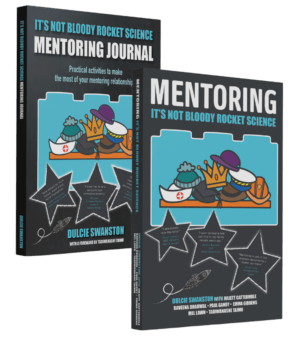
As I’ve mentioned in the first two newsletters in this series, when we were writing our book Mentoring – It’s Not Bloody Rocket Science, we wanted to make it really easy for mentors to recognise what sort of support their mentee might need, and to adapt their approach accordingly.
And we came up with 8 different mentoring hats.
The first was the Coach, the second the Reassuring Strong Presence, and now we’re onto the Firm Foundation Builder.
And this one is particularly important because, whilst we’re passionate advocates of coaching at 100Brix , there’s something I’ve been saying for years:
Sometimes absolutely don’t coach.
You can’t coach someone to know something they’ve never been taught.
It’s a really important distinction.
Sometimes somebody comes to you because they’re struggling with something, and your instinct, particularly if you’ve had some coaching training, might be to ask them a series of brilliant questions. 20 years ago I did this too – almost permanent coach mode as I was such a convert!
But what if they simply don’t know how to do it?
What if they haven’t got the knowledge, experience or understanding to answer those questions?
You can ask somebody how they might approach a task until you’re blue in the face, but if they’ve never been shown how to do it, you might actually be making life harder for them!
Making them feel frustrated, inadequate or switch their Imposter on (“I knew this step up was a step too far for me”).
Creating feelings in others that were likely to be at the opposite end of the scale from your intentions.
Instead of coaching when it is not an opportunity to coach, that’s when you might need to put on your Firm Foundation Builder hat FIRST.
So what does a Firm Foundation Builder actually do?
This is the mentor who switches to providing practical, hands-on support.
Somebody who is patient, happy to share their knowledge and experience, and who understands that sometimes people need to be shown how to do something before they can confidently do it for themselves.
They might provide a template, demonstrate a technique, explain a process or share a shortcut that they’ve learnt through experience.
They might say:
“Shall I show you a shortcut I learnt?”
“In my experience, this tends to work better than that, and here’s why.”
“I’ve got a template for that which might help you get started.”
It’s not about doing somebody’s job for them. It’s about helping them to build the knowledge, skills and confidence that will enable them to do it for themselves.
And we think the construction metaphor is rather a good one. You wouldn’t expect somebody to build a house without understanding the basics of construction. And you certainly wouldn’t expect the roof to stay up if the foundations weren’t sound!
But sometimes that’s exactly what we do in business.
We expect people to perform tasks that they’ve never been properly taught how to do, and then wonder why they’re struggling.
🧠 And there’s some really interesting science behind this.
One of the reasons this approach works is something called cognitive load theory, developed by educational psychologist John Sweller.
Our working memory, the part of our cognitive system that holds and processes information we’re using right now, has a limited capacity.
So when we’re learning something completely new, we can quickly overwhelm or fill up that capacity if we’re expected to work everything out for ourselves.
And when that happens, learning can become much harder – because you just don’t have the capacity to remember what you are being told, or to work it out for yourself – you don’t have the ‘brain fuel’ to do those basics.
You can’t drive a route to work, even if you know it really well if you don’t have fuel in your tank right?
It’s the simplest analogy I can make – even if ‘brain fuel’ isn’t loved as a strictly scientific term – because if it sticks in your head it is good enough right?!
Research into something called the worked example effect suggests that, particularly when we’re novices, being shown how to solve a problem can be more effective than being left to work it out through trial and error.
Essentially, by showing somebody the steps, demonstrating what good looks like, or providing a framework to follow, we’re reducing the unnecessary mental effort involved in figuring out where to start. Which leaves more of their working memory available for actually learning.
A 2024 review of research into expert guidance and learning also explored how breaking information into manageable chunks and directing attention to important details can help novices deal with cognitive load.
It’s one of the reasons why good mentoring can be so valuable.
You’re not simply sharing information. You’re making it easier for somebody else’s brain to understand and use it.
But there’s another important part to taking this Firm Foundation Builder hat out of your wardrobe…
You have to know when to take the hard hat off!
Because the same research suggests that as somebody becomes more knowledgeable and experienced, too much instruction can actually become unhelpful.
Once they’ve built those foundations, they need the opportunity to practise, experiment, make decisions and develop their own judgement.
The problem is, you might be on a roll! Enjoying being helpful and showing people what to do – beyond the point that they actually need it.
And imagine you are more senior – or they have so appreciated your help – imagine them trying to tell you ‘enough…let me work it out myself now…’
So here’s why we like the hats. It is a reminder to change them. And here you might swap your Firm Foundation Builder hat for that Coach hat – that absolutely was not suitable at the start.
Now, instead of showing them how to do something, you can start asking them how they might approach it themselves.
The skill is recognising when to make that switch.
So how do you know when to wear this hat?
Listen carefully to the language your mentee is using. If they’re saying things like:
“I’ve never done this before.”
“I don’t know where to start.”
“Can you show me how?”
Then they may well be asking you to put on your Firm Foundation Builder hat. And rather than responding with a coaching question, perhaps the most helpful thing you can do is share something practical that will help them get started.
But remember, the clue is in the title ‘foundation’. This doesn’t mean telling them everything you know about the subject!
Quite the opposite.
Give them enough to get going, check their understanding, and then let them have a go.
You can always come back and build another layer.
Because the whole point of being a Firm Foundation Builder is to help somebody become capable and confident enough that they no longer need you to wear that particular hat.
And that’s a pretty good outcome for any mentor.
Sometimes people don’t need another question. They need a foundation to build from.
And remember, good mentors have a favourite hat. Great mentors have a wardrobe!
🔬 For those who enjoy going down the neuroscience rabbit hole…A little more reading on the research behind this approach:
John Sweller and colleagues – Cognitive Load Theory and Worked Examples. Research explaining why worked examples and explicit guidance can support people learning unfamiliar, complex tasks.
Paas & van Merriënboer (2020) – Cognitive-Load Theory: Methods to Manage Working Memory Load in the Learning of Complex Tasks. Particularly interesting on why guidance should gradually reduce as somebody becomes more experienced.
Van Nooijen and colleagues (2024) – A Cognitive Load Theory Approach to Understanding Expert Scaffolding of Visual Problem-Solving Tasks. A review exploring how experts help novices learn by directing attention and breaking information into manageable chunks.


We listen. We understand. We are confident that we can create a bespoke solution
that really adds to your bottom line.