
The 8 Hats of Great Mentoring: Confidence Building Coach
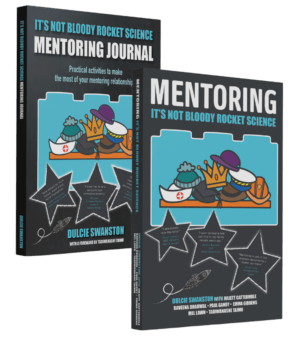
The biggest challenge that we experienced as a writing team when creating the recently released book Mentoring – It’s Not Bloody Rocket Science, was making sure that busy senior leaders taking on a mentoring role could quickly assimilate and remember the neuroscience that sits underneath successful human mentoring partnerships.
It took me 2 years – and the recruitment of a co-writing team – to successfully test and distil everything that I had learnt from science and research about mentoring, into a simple training session that can be delivered in just 2 hours…
Sometimes it takes a long time to make the complex simple!
But we think we succeeded – and I’m going to let you know about the cat and the hats in reverse – the 8 hats and then the CAT…
A mentor is likely to be someone with experience or seniority – who is asked to share their knowledge to support someone else. That experience can be about technical knowledge or the more subtle understanding we get about workplaces or market trends that we pick up over time – and often by getting it wrong a few times to learn how to get it right.
As a result a good mentor will come to know which ‘hats’ they wear well. What they are ‘famous’ for.
It could be that someone is asked to be a mentor because they are ‘famous’ for their deep expertise about a particular topic, or in demand as a mentor because just being in their presence somehow gives others the reassurance and confidence they need to fly.
However, what we came to realise as a writing team is that GREAT mentors don’t just wear the hat that suits them. They are able to ADAPT – to change hats and wear one which perhaps would not be their first choice of wardrobe attire – but is the one their mentoring partner needs on that particular day in that particular session. Hence the idea of a mentoring ‘wardrobe’ was born. 8 hats. Worn deliberately and intentionally by great mentors to match what their partner needs. Not everyone will be great at wearing every hat. Some mentors might stick to one or two and make sure that is what their mentoring partner needs upfront.
But the great news for leaders wanting to mentor flexibly across their organisation or sector, is we think that wearing all the hats can be learnt.
The first step is understanding which hat you wear easily. Perhaps you don’t even realise how much it suits you! But the downside to that could be, that you might also not realise how often you have it on your head on autopilot.
Like a favourite hat, it could be the one you simply grabbed as you left the house…but before checking what the weather was doing (or in my case, whether, if you need to take it off later your hair would be up to being seen without it!)
So we are going to share the hats. 👑🎓👷🏽🚀 One by one. Week by week. You can decide which you wear easily and which you might need some feedback or training to enable it to suit you. But don’t worry – that’s self awareness and a trainable skill, not a wardrobe failure.
🧢Hat 1: The Confidence Building Coach
Sometimes people ask you:
“What do you think I should do?”
Or:
“What would you do if you were me?”
And our natural response might be to tell them. Certainly as an experienced cross functional leader – and I hope a person who is perceived to be helpful – that is what I used to do all the time…
And sometimes that’s absolutely right.
If someone lacks skill or experience, they may genuinely need advice or you to show them what to do.
But before you jump into doing that on autopilot just pause. Remember sometimes they might be asking for what sounds like advice not because they don’t know the answer but because they lack confidence in their ideas about the answer…
Or maybe they want reassurance – or just your attention. Or maybe they lack motivation and it just feels easier to be told.
And actually, in those circumstances, we need to be really, really careful.
Because giving advice before we’ve checked whether people really need it can suggest to another human brain, subconsciously, that they were right to not take action before they checked in with us first. That their lack of confidence was well placed. That they need us more than they actually do.
One of the most common things I identify weekly in my work supporting organisations and teams to be more productive – to do more with less time – is exceptionally well-intentioned, helpful leaders, accidentally ‘stealing’ the opportunity for someone in their team or organisation to learn to think better for themselves when they personally aren’t available.
And this is important because no one has ever said to me in 15 years of consulting on leadership issues:
“Dulcie I really want my team to be less accountable and not at proactive – can you help?”
That’s where our Confidence Building Coach hat comes in.
Wearing this hat means taking a beat. To ask a question to check you understand what someone really wants from you – before giving that advice.
It’s about giving people space to think.
It’s about asking open questions with curiosity…
…and not a shred of judgement (bloody difficult for the previously ‘very judgy and very keen to fill a silence’ historical version of me!)
And there’s some useful science behind it.
Psychologists call one part of this the generation effect. Broadly speaking, we tend to remember information better when we’ve had to generate it ourselves rather than simply being given it. You can go down a rabbit hole on the research if that is your thing here:
The generation effect: a meta-analytic review – PubMed
There’s also good evidence around autonomy. When people experience more choice and ownership over what they do, rather than simply being told what to do or micro-managed, it is associated with more autonomous motivation and positive workplace outcomes.
Self‐Determination Theory and Workplace Outcomes: A Meta‐Analysis
Which is why sometimes the most useful thing we can do as mentors is resist the urge to provide the answer for a moment. And instead reach for our coach hat.
Pause to ask:
“What do you think you should do?”
or
“What options have thought about and discounted?”
or
“What would you do if you knew you could not fail?”
And then…
…shut up, stay attentive and give them enough space to answer.
Because what I have come to know through training as a coach is sometimes people don’t need your answers – or at least not yet
They need help finding or exploring their own.
And if the purple coaching cap you see me wearing in the video here isn’t a hat you wear naturally, don’t worry!
What Makes a Great Mentor? | Top Right Thinking
It wasn’t one that used to be in my wardrobe either! And now, 15 years later, I’m as qualified and as accredited as you can get so I am personal evidence that you can teach and old dog new tricks…
Coaching is a skill. It can absolutely be learnt.
I hope that knowing this cap can absolutely be learnt, alongside the other 7 hats, gives you all you need to know about great mentoring and whether you can be one…
…Great mentors have a wardrobe.
And we have a brilliant hat shop – so we are bound to be able to find a version of at least 6 of the 8 hats that will absolutely suit you (sir!)


We listen. We understand. We are confident that we can create a bespoke solution
that really adds to your bottom line.